

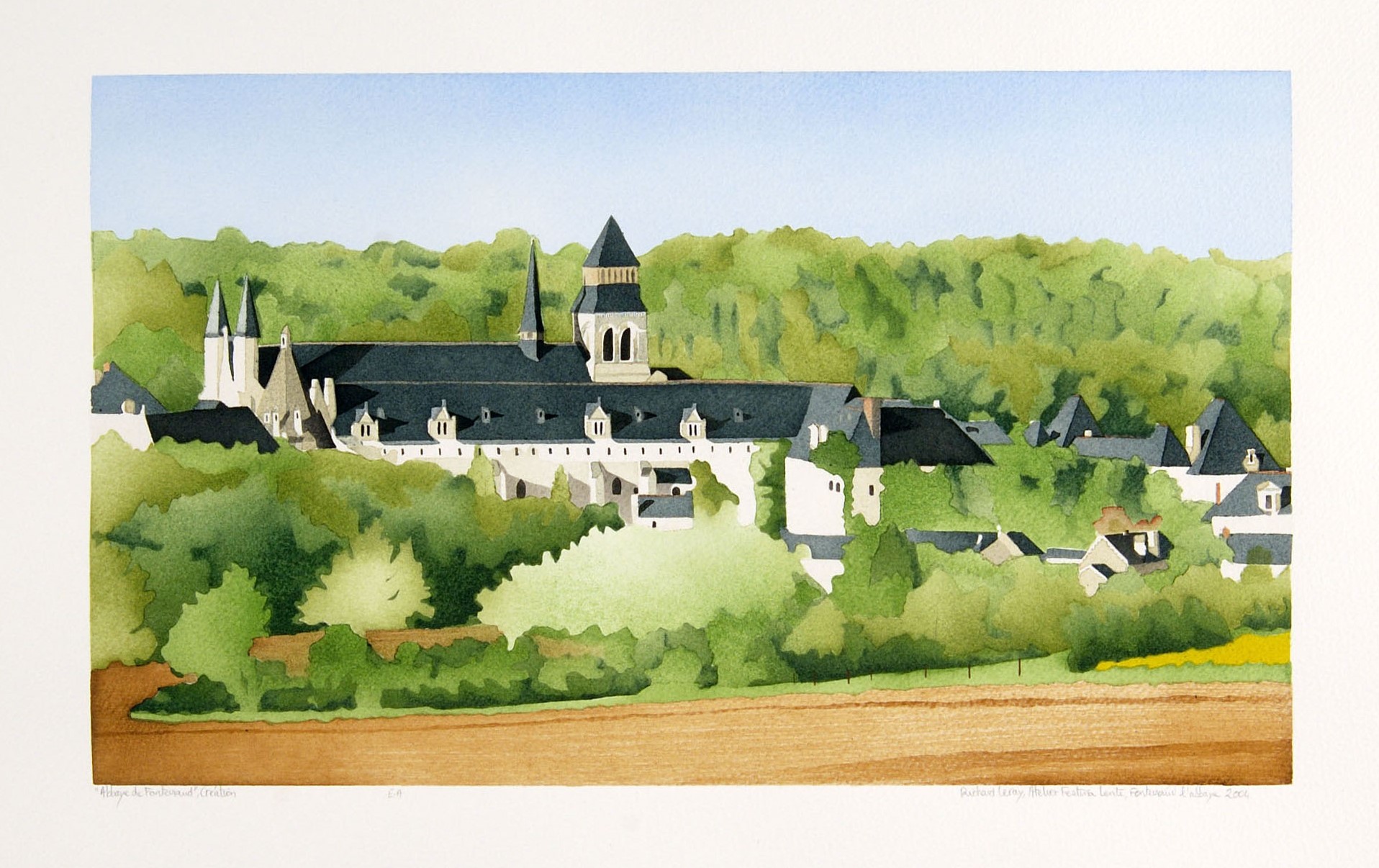
Création, 2004
Dernier exemplaire sur 64
Papier Arches pur coton 250 grammes
Numéroté E.A, Epreuve d’Artiste
Format encadré: 44 x 56 cm
Encadrement Clear Color, anti-reflet, anti-UV
1150 €, encadrement compris
Vendu
En 2004, il m’importait de fêter les dix ans de mon atelier à Fontevraud-L’Abbaye. L’esprit de ce sujet était de reproduire l’abbaye dans son environnement humain, géographique, et avec les matériaux qui ont participé à sa construction.
Il me faut remercier les responsables et services techniques de l’abbaye qui m’ont autorisé à prélever du tuffeau et de l’ardoise du sarcophage de Raymond 7, duc d’Aquitaine, datant du 13ème siècle, inhumé, suivant sa demande auprès de sa mère Jeanne d’Angleterre, son oncle Richard Cœur de Lion et de son grand-père Henri II Plantagenêt, au sein de l’abbaye
J’ai utilisé la base du sarcophage en tuffeau pour la partie murale, le couvercle en ardoise pour la toiture.
L’absence totale de mécanisation ou de passage sous presse dans l’enluminure d’art au pochoir autorise l’utilisation de ces produits particuliers, de les poser en épaisseur. L’absence de trait cernant les couleurs oblige à des découpes des caches et des raccords le plus parfait possible.
Abbaye de Fontevraud
Creation, 2004
Last copy of 64
Pure coton Arches paper
Numbered E.A, Epreuve d’Artiste, Artist’s proof
Framed Format: 44 x 56 cm
Clear Color frame, anti-reflective, anti-UV
1150 €, including framing
Sold out
In 2004, it was important for me to celebrate the tenth anniversary of my workshop in Fontevraud-L’Abbaye. The idea of this project was to reproduce the abbey in its human and geographical environment, and with the materials that participated in its construction.
I must thank the managers and technical services of the abbey who allowed me to take some limestone and slate from the sarcophagus of Raymond 7, Duke of Aquitaine, dating from the 13th century, buried, following his request to his mother Joan of England, his uncle Richard the Lionheart and his grandfather Henry II Plantagenet, whithin the abbey.
I used the base of the tuffeau ot limestone sarcophagus for the wall part, the slate lid for the roof.
The total absence of mechanization or mechanical printing in the art of stencil illumination authorizes the use of these particular products, to lay them in thickness. The absence of a line surrounding the colors requires the cutouts of the stencils and the connections to be as perfect as possible.


